

Imagine walking into a store and finding the perfect complementary products right where you need them. You pick up a coffee maker and immediately spot a discounted pack of coffee filters and a popular brand of coffee beans nearby. That’s no accident. Behind the scenes, item basket analysis is quietly shaping that experience, turning simple sales data into a powerful revenue engine.
Item basket analysis digs deep into what customers buy together, revealing patterns that can transform retail strategies. This isn’t guesswork or gut feelings-it’s data-driven insight that helps businesses boost sales, optimize inventory, and create smarter promotions. Let’s explore how this analytical approach works and why it’s a game changer for retailers.
Why Basket Analysis Beats Guesswork in Retail Strategy
Retailers have long relied on intuition and experience to decide which products to place together or promote simultaneously. While seasoned merchandisers have valuable instincts, these can’t match the precision of data-backed insights. Basket analysis uses actual transaction data to uncover which items customers frequently buy together, revealing hidden relationships that might otherwise go unnoticed.
For example, a grocery store might assume that chips and soda are a natural pairing. Basket analysis might confirm this but also uncover less obvious combos, like hummus and pita bread or specific types of wine paired with certain cheeses. These insights help retailers tailor their store layouts and marketing efforts to real customer behavior, not assumptions.
Studies show that retailers who implement basket analysis can increase cross-sell and upsell success rates by up to 20%. This improvement translates directly into higher average transaction values and better customer satisfaction. When customers find complementary products easily, they’re more likely to buy more and return in the future.
Moreover, the power of basket analysis extends beyond just physical retail spaces. E-commerce platforms can leverage this data to enhance their online shopping experiences. By analyzing customer purchase patterns, online retailers can create personalized recommendations that appear during the shopping journey, effectively guiding customers toward items they may not have initially considered. This personalized touch not only boosts sales but also fosters a sense of connection between the brand and the consumer.
Additionally, basket analysis can inform promotional strategies, allowing retailers to design targeted marketing campaigns that resonate with specific customer segments. For instance, if data reveals that a significant number of customers purchase organic pasta alongside a particular brand of sauce, a retailer might run a promotion that bundles these items together at a discount. This not only incentivizes purchases but also enhances the overall shopping experience by making it easier for customers to find what they need, ultimately driving loyalty and repeat business.
Cross-Sell Tactics Backed by Real Data (Not Intuition)
Cross-selling is an art and a science. Done right, it enhances the shopping experience and boosts revenue. Done poorly, it can feel pushy and drive customers away. Basket analysis provides the science part, giving retailers clear guidance on which products to recommend together.
Here’s how data-backed cross-selling works:
- Identify strong item affinities: Analyze transaction data to find pairs or groups of products frequently purchased together.
- Segment customers: Use purchase history to tailor recommendations to specific customer groups, increasing relevance.
- Optimize timing: Present cross-sell offers at the right moment-online during checkout or in-store near related products.
For instance, an online electronics retailer might discover that customers who buy a smartphone often purchase screen protectors and cases within a week. By proactively recommending these items during checkout or via follow-up emails, the retailer can increase sales without annoying the customer.
Data-driven cross-selling also helps avoid common pitfalls, such as pushing irrelevant products that dilute the brand or confuse shoppers. Instead, it builds trust by offering genuinely useful suggestions based on real buying patterns.
Moreover, the integration of advanced analytics tools allows retailers to refine their cross-selling strategies continuously. By leveraging machine learning algorithms, businesses can uncover deeper insights into customer behavior, predicting not just what products may be bought together but also the optimal price points for these items. This ensures that the recommendations are not only relevant but also financially attractive to the consumer, enhancing the likelihood of conversion.
Additionally, the effectiveness of cross-selling can be further amplified by incorporating customer feedback into the data analysis process. By monitoring customer interactions and soliciting reviews on recommended products, retailers can fine-tune their offerings and improve the overall shopping experience. This creates a feedback loop where both the retailer and the customer benefit, fostering loyalty and encouraging repeat purchases as customers feel their preferences are being acknowledged and valued.
Triplets: The Holy Grail of Merchandising Combos
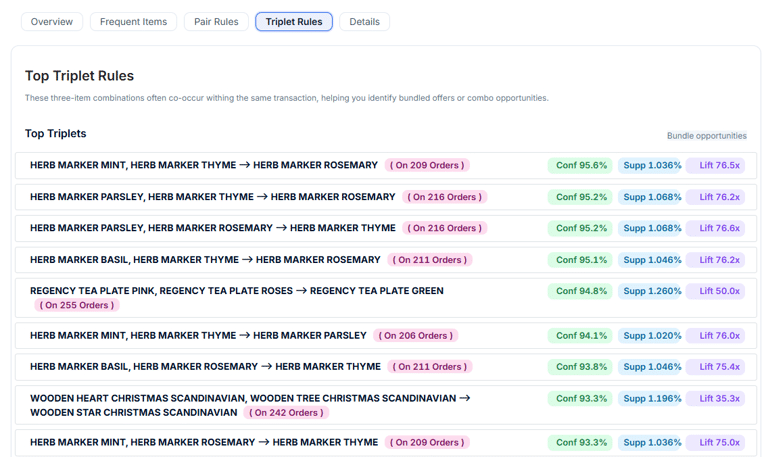
Most basket analysis focuses on pairs of items, but triplets-groups of three products frequently bought together-offer even richer insights. These combos can reveal complex purchasing behaviors and open new merchandising opportunities.

Consider a bakery that notices customers often buy coffee, a croissant, and a fresh juice together. Highlighting this triplet as a bundled breakfast deal can increase sales across all three categories. Triplets also help retailers design more effective product bundles and promotions that resonate with customer habits.
Finding these triplets requires more advanced analytics because the combinations multiply exponentially as more items are considered. Thankfully, modern predictive analytics platforms make this process accessible without needing a data science team.
Retailers who leverage triplet analysis can:
- Create compelling product bundles that increase average order value
- Optimize store layouts by grouping high-affinity triplets together
- Design targeted promotions that reflect real-world buying patterns
In fact, research indicates that triplet-based merchandising can boost basket size by up to 15%, making it a powerful tool for competitive differentiation.
How to Use Item Affinities in Promotions Without Killing Margins
Promotions are a double-edged sword. While they can drive volume, they often squeeze profit margins. The key is to use item affinities strategically to craft promotions that encourage higher spending without deep discounts that erode profitability.
Here are some tactics to consider:
- Bundle smartly: Combine high-margin items with popular lower-margin products to balance profitability.
- Use tiered discounts: Offer incremental savings when customers buy multiple related items, encouraging larger purchases.
- Leverage loyalty programs: Reward customers for purchasing affinity items together, increasing lifetime value.
For example, a cosmetics retailer might promote a skincare set where the main product is full price, but complementary items like serums or masks have modest discounts. This approach nudges customers to buy more without sacrificing margin on the hero product.
Another approach is to use data to identify items with high affinity but low price sensitivity, enabling promotions that increase volume without steep price cuts. This kind of precision targeting is only possible with robust basket analysis.
Implementing a Data-Driven Merchandising Playbook
Turning basket analysis insights into action requires a structured approach. Here’s a step-by-step playbook to get started:
- Collect and clean transaction data: Ensure your sales data is accurate, comprehensive, and well-organized.
- Analyze item affinities: Use analytics tools to identify pairs, triplets, and larger item combinations.
- Segment customers: Group shoppers by behavior, preferences, and purchase history.
- Develop merchandising strategies: Design store layouts, bundles, and promotions based on affinity insights.
- Test and measure: Run pilot programs and track key metrics like basket size, conversion rates, and margins.
- Refine and scale: Use feedback and data to improve tactics and roll out successful strategies broadly.
Integrating basket analysis into your merchandising strategy isn’t a one-time project; it’s an ongoing process. Retailers who commit to continuous learning and adaptation can stay ahead of customer trends and maximize revenue opportunities.
Leading retailers report that data-driven merchandising decisions improve not only sales but also inventory turnover and customer loyalty. With the right tools and mindset, basket analysis becomes a cornerstone of a smarter, more profitable retail operation.
Unlock Your Retail Strategy’s Full Potential with Graphite Note
Ready to transform your item basket analysis into a robust, revenue-generating strategy? Graphite Note is here to empower your data analysis without the complexity of coding. Our intuitive platform allows you to create machine learning models in minutes, turning your data into actionable insights that drive sales, improve inventory turnover, and enhance customer loyalty. Don’t let the opportunity to leverage AI for your business slip away. Try Graphite Note Now and start making data-driven decisions that propel your retail operation forward.