I have been in data analytics for more than twenty years.
I started in the era of Java batch scripts and complex SQL that produced “the report.” Back then, success meant delivering the numbers on time. Accuracy was everything. Interpretation was someone else’s job. The technical challenge was getting the query right and making sure the batch job did not fail at 2 a.m.
Then came the BI revolution. Drag-and-drop tools. QlikView’s in-memory engine. Tableau dashboards everywhere. Suddenly insight was democratized. Executives could slice and drill without waiting for IT. Data became visual. Interactive. Accessible. It felt transformative.
And it was.
But something strange kept happening.
After the dashboard was shown. After the trend line was explained. After the heatmap was admired.
The room would go quiet.
And someone would ask:
“Ok. What should we do now?”
Fast forward to 2015. I moved deeper into data science and machine learning. Forecasting demand. Predicting churn. Classifying defects. Optimizing production parameters. The math got better. Accuracy scores improved. Models could anticipate patterns we could never see in static reports.
And still, in meeting after meeting, the same question appeared.
What should we do?
That question is the missing product.
Not a chart. Not a model. A decision.
This is why Decision Intelligence matters.
I’ve been following David Pidsley updates closely recently. https://www.linkedin.com/pulse/decision-intelligence-platforms-david-pidsley-gelne/ ; also interesting take from Anton Talantsev here: https://www.linkedin.com/pulse/2028-decision-centric-overtake-data-driven-data-ready-anton-talantsev-xkzvf
The first ever Gartner Magic Quadrant for Decision Intelligence Platforms was published and became the most-read Magic Quadrant across Gartner for the third week running. Then Gartner identified Decision Governance as a top trend. DI is clearly moving from concept to category.
But here is the part that deserves a serious conversation. The market narrative around Decision Intelligence is moving in a particular direction. Gartner’s Magic Quadrant for Decision Intelligence Platforms places strong emphasis on decision governance, stewardship, traceability, explainability, and execution control. In Gartner’s framing, DI platforms help organizations “model, manage, monitor and optimize decisions” with increasing focus on governance structures and oversight mechanisms.
That emphasis is not wrong. At scale, unmanaged automated decisions create financial, operational, and reputational risk.
However, what I observe in practice is that Decision Intelligence is quietly splitting into two entry paths.
The Control Path and the Intelligence Path.
The Control Path is governance-first. It focuses on decision catalogs, approval workflows, audit trails, policy enforcement, explainability documentation, compliance controls, and oversight frameworks. It assumes that decision automation is already institutionalized and the primary challenge is managing risk, ensuring accountability, and maintaining traceability at scale.
The Intelligence Path is model-first. It focuses on building structured predictive models on transactional ERP and CRM data, estimating causal impact of actions, simulating trade-offs, and producing recommendations that operational teams can use. It assumes that many organizations have not yet formalized their decision logic and are still operating through dashboards, spreadsheets, and informal overrides.
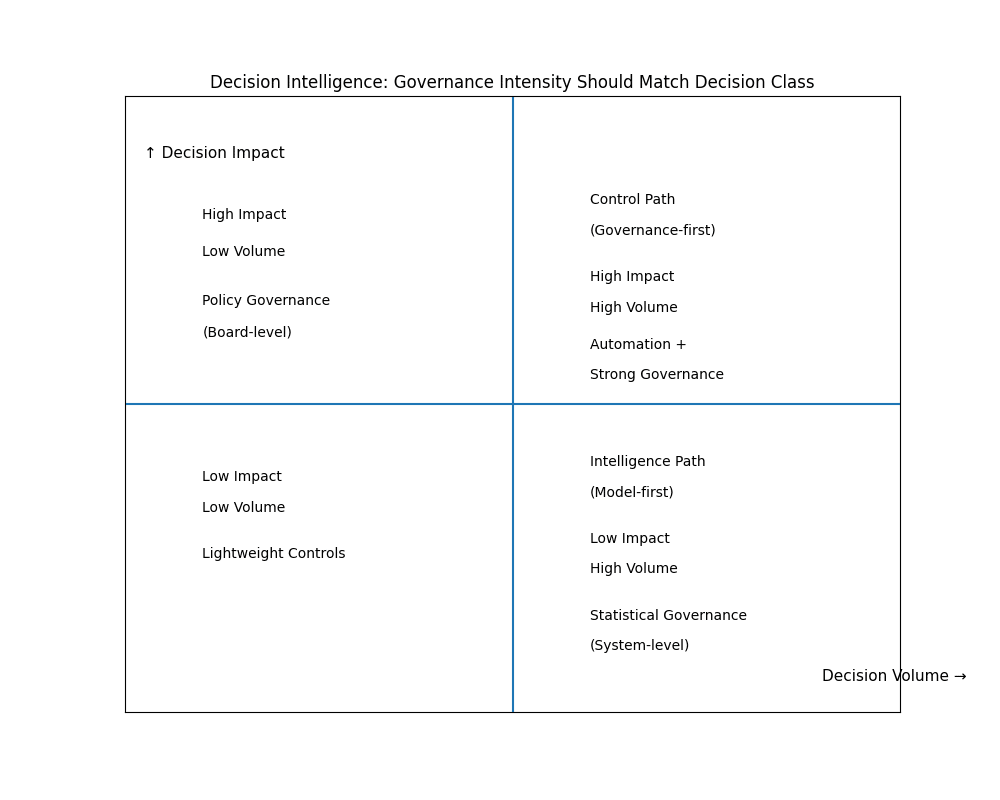
The image shows a simple 2×2 matrix arguing that governance intensity should match the type of decision being made. The vertical axis represents decision impact (low to high) and the horizontal axis represents decision volume (low to high). In the bottom-left quadrant (low impact, low volume), only lightweight controls are needed. In the bottom-right quadrant (low impact, high volume), such as SKU replenishment decisions, governance should be statistical and system-level, focused on monitoring and thresholds rather than manual approvals. In the top-left quadrant (high impact, low volume), like strategic hiring or factory expansion, governance is policy-driven and board-level. In the top-right quadrant (high impact, high volume), strong automation plus robust governance is required. The core message is that not all decisions require the same governance model, and Decision Intelligence must scale oversight based on impact and velocity.
These are not competing ideologies … They are different starting points.
To understand why this matters, we need to talk about decision classes.
Consider a retailer managing 50,000 SKUs across multiple warehouses. A replenishment model recommends reorder points, reorder quantities, and safety stock levels every week. That could mean hundreds of thousands or even millions of operational decisions per month.
Should each SKU recommendation require committee review? Manual sign-off? Formal approval workflows? Obviously not. That would paralyze the system and destroy the speed advantage of automation.
What governance makes sense in this context?
Model versioning. Input traceability. Statistical monitoring of forecast error. Threshold alerts when reorder quantities deviate beyond defined tolerance bands. Exception handling for anomalies. Outcome tracking such as service level, stockouts, and inventory turns.
This is statistical governance.
It operates at the system level, not at the individual decision level.
Now contrast that with a strategic decision.
Should we build a new factory? Should we hire 200 additional workers? Should we enter a new country? Should we acquire a competitor?
These are low-frequency, high-impact, low-reversibility decisions. They often rely on external market assumptions, macroeconomic projections, regulatory analysis, and leadership judgment. They are not purely derived from first-party ERP data.
Governance here looks very different.
Formal documentation of assumptions. Scenario stress testing. Explicit articulation of trade-offs. Sensitivity analysis. Risk exposure modeling. Board-level review. Clear ownership and accountability.
This is policy governance.
It operates at the decision level.
The mistake is assuming that one governance model fits all decisions.
Governance intensity should scale with impact, irreversibility, and exposure.
High volume, low individual impact, high reversibility decisions require automated statistical oversight.
Low volume, high impact, low reversibility decisions require structured human governance.
And here is where the tension becomes visible.
Many governance-heavy Decision Intelligence platforms implicitly assume that structured decision logic already exists. That predictive models are embedded into workflows. That causal reasoning about action impact is formalized. That enterprises have already institutionalized decision automation.
But walk into most companies and you will see a different picture.
Forecasts debated in meetings and manually adjusted in Excel.
Dashboards reviewed but not directly connected to action.
Machine learning pilots living in isolated notebooks.
Promotion effectiveness rarely measured through causal testing.
Safety stock formulas hard-coded years ago and rarely revisited.
This is not primarily a governance failure. It is intelligence that has not yet been built.
You cannot govern what has not been formalized. This is why sequence matters.
Stage one is building intelligence. Formalizing decision logic. Connecting predictive models to real transactional data. Estimating not just what is likely to happen, but what will change if we act. Translating predictive signals into recommended actions with explicit constraints and trade-offs.
Stage two is scaling responsibly. Introducing ownership, monitoring, traceability, and guardrails. Ensuring model drift is detected. Ensuring bias is monitored. Ensuring recommendations remain aligned with policy.
Stage three is institutional governance. Integrating decision catalogs, enterprise risk frameworks, compliance requirements, and board-level oversight into the decision fabric of the organization.
Gartner is directionally correct that decision stewardship becomes critical as automation velocity increases. Once thousands of decisions are executed automatically per hour, governance is not optional.
But many organizations are being encouraged to implement enterprise-grade governance frameworks before they have operationalized even basic predictive and causal models on their transactional data.
That creates a structural mismatch.
It is like installing air traffic control systems before you have airplanes in the sky.
Decision Intelligence is not primarily about governance.
It is about closing the loop between insight and action.
Predictive models answer what is likely.
Causal models answer what will change if we intervene.
Prescriptive logic answers what we should do under real-world constraints.
Governance ensures that when those answers are executed at scale, they remain aligned with policy, ethics, and risk tolerance.
Both paths matter.
But the entry point should reflect organizational maturity.
If your organization is already automating pricing decisions, credit approvals, or dynamic supply allocations at high velocity, the Control Path is urgent.
If your organization is still debating last month’s performance dashboard in PowerPoint, the Intelligence Path is the more immediate constraint.
Across two decades, I have watched analytics evolve from reporting to visualization to prediction.
Each wave solved part of the problem.
Reporting delivered visibility.
BI delivered accessibility.
Data science delivered predictive power.
Decision Intelligence must deliver action.
If we start with control before we build intelligence, we risk governing an empty shell.
If we build intelligence without oversight, we risk scaling error.
The real opportunity is recognizing that Decision Intelligence is not a monolithic category. It is an evolutionary journey shaped by decision class, automation velocity, and organizational maturity.
Most companies are earlier in that journey than market narratives imply.
That is not criticism. It is diagnosis.
And good diagnosis is the first step toward better decisions, right? 🙂