
Client context
The Challenge at a Glance
| Company | True Corporation (True Business) |
| Sector | Telecommunications |
| Headquarters | Thailand |
| Customer Base | 55 million consumer customers |
| Use Case | Telco · Lead Scoring & Customer Targeting |
| Platform | Graphite Note |
The problem
High Reach. Low Conversion. High Cost.
True Corporation’s tele-sales team was reaching 56% of prospects across upsell campaigns — a respectable contactable rate. But only 1.9% of those conversations turned into revenue. The company was investing heavily in outreach that wasn’t converting, and the volume of inbound leads far exceeded the capacity of the sales floor to handle them intelligently.
Pain points confirmed during discovery
- Conversion rate of just 1.9% — despite a 56% contactable rate, the vast majority of interactions produced no revenue
- No prioritisation logic — agents contacted leads in sequence, not by likelihood to convert
- Capacity mismatch — tele-sales headcount could not scale to lead volume without smarter prioritisation
- Product-to-customer mismatch — cross-sell recommendations were not aligned to individual customer profiles or product gaps
- Operational drag — manual campaign processes consumed time that should have been spent selling
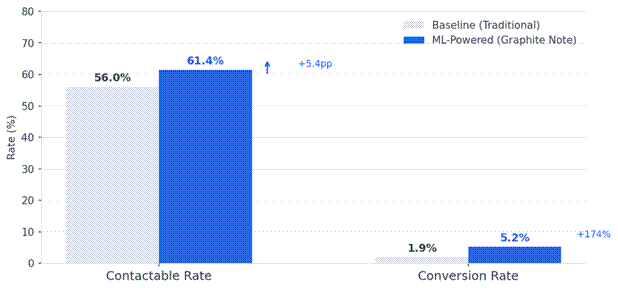
Contactable Rate and Conversion Rate — Traditional vs. ML-Powered Approach. Overall conversion rate improved by 174% on comparable outreach volume.
The approach
Four Workstreams. One Platform.
True Business adopted Graphite Note’s no-code ML platform to execute a structured, four-workstream programme designed to move every stage of the targeting process from intuition to evidence.
| Phase | Objective | Timeline | Deliverables |
| Phase 1 | Data audit, customer segmentation & baseline modelling | Weeks 1–3 | Segmentation clusters, baseline metrics |
| Phase 2 | Predictive modelling, lead scoring & personalised offer engine | Weeks 4–8 | Scoring model, offer engine, live dashboard |
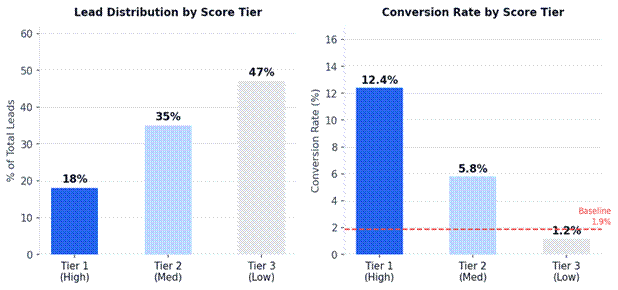
Lead Scoring “Illustrative example of lead scoring tier output
Four Principles That Drive the Methodology
Customer Segmentation. Clustering models segmented the full customer base into behavioural cohorts. Each segment was profiled by product usage, spend patterns, and engagement signals — replacing broad demographic cuts with precision targeting.
Predictive Modelling. A model trained on historical conversion outcomes incorporated product-gap segmentation and typical buying behaviour by category. Each customer received a probability score, enabling the team to rank the call list by likelihood of success.
Personalised Offers. Product recommendations were matched to individual customer profiles based on gap analysis — ensuring agents led every conversation with the most relevant offer rather than a generic catalogue pitch.
Lead Scoring for Cross-Sell. The scoring layer prioritised the full lead pool by conversion probability, directing sales capacity toward the highest-value prospects first. Agents no longer worked an undifferentiated list — they worked a ranked one.
Results
What the Engagement Produced
Conversion Rate
The move from broad outreach to ML-prioritised calling drove a 174% increase in conversion rate. Agents reached fewer wrong-fit customers and spent more time on conversations with genuine purchase intent. The 5.2% conversion rate was achieved on comparable outreach volume — meaning the improvement came entirely from targeting quality, not from expanding effort.
Contactable Rate
Segmentation-driven targeting improved reachability by routing contacts through the most effective sales channels for each product category. The improvement from 56% to 61.4% reflected a better match between channel strength and customer profile — a direct output of the sales channel analysis workstream.
Operational Time
The largest gain came from replacing manual campaign logic with automated scoring and offer generation. Time previously absorbed by list preparation, segmentation review, and ad hoc prioritisation was redirected to selling. The 76.67% reduction in operational time represents compounding capacity — the same team could now work a far larger and better-qualified pipeline.
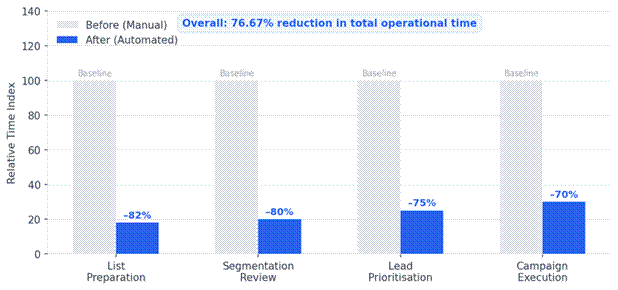
Operational time reduction by campaign stage. ML automation eliminated 76.67% of total campaign overhead across all four stages.
CLIENT VOICE
In Their Own Words
| “Graphite Note gave us a way to turn our data into decisions without waiting for data scientists. We went from manual list-pulling to a ranked, scored pipeline in weeks. The impact on conversion rates and team efficiency was immediate.” — True Business Marketing Team, True Corporation Thailand |
Why Graphite Note
Built for This Problem
True Corporation evaluated multiple approaches to integrating machine learning into their sales operations. What differentiated Graphite Note was the ability to deploy predictive models without engineering dependency — business analysts could build, validate, and act on models directly. For a team operating in a competitive, high-velocity telecom market, that speed was decisive.
| ML Platform | Business teams build predictive models without engineering bottlenecks |
| Customer Segmentation | Clustering models reveal distinct behavioural cohorts — no SQL required |
| Predictive Lead Scoring | Rank every prospect by conversion probability and act on what matters |
| Personalised Offer Engine | Product-gap analysis drives relevant cross-sell and upsell recommendations |
| Decision Science Layer | From model output to step-by-step strategy — actionable, not just analytical |
| Speed to Value | Working models in days, not months — no infrastructure build-out required |