
Client context
Challenge at a Glance
| Company | Major European resort operator — hotels, camps, and vacation apartments across a prime coastal destination |
| Scale | 3.8M+ guest accounts; 7.5M+ historical reservation records |
| Vertical | Hospitality & Tourism |
| Core Challenge | Guest database with no actionable audience layer — marketing operated on intuition, not data |
| Input | Raw CRM export files — no preprocessing, no BI layer, no manual client preparation |
The problem
“We Have 3.8 Million Guests. We Don’t Know Who They Are.”
A large guest database is not the same as guest intelligence. This hospitality group had years of reservation history and a rich CRM — but no systematic way to turn that data into audience definitions that marketing could actually use.
The gaps were operational and strategic:
- No behavioural segmentation — no distinction between loyal high-value guests and dormant accounts that hadn’t returned in years.
- No property-preference layer — the team couldn’t identify which guests consistently chose premium hotels versus budget camps or apartments.
- No travel party profiles — families, couples, solo travellers, and multi-generational groups were all treated identically.
- No experience interest scoring — despite holding 34 distinct interest flags per guest in the CRM, these had never been weighted or combined into actionable categories.
- No cross-dimension view — even if individual answers existed, there was no way to combine them: ‘Which high-value couples are interested in wellness but haven’t visited in two years?’
Campaigns were broad. Offers were generic. Personalisation was aspirational rather than operational.
The approach
Four Segmentation Dimensions. One Integrated Output.
Graphite Note designed and delivered an end-to-end Decision Intelligence engagement — from raw CRM export to a fully structured audience layer — with no manual data preparation required from the client team.
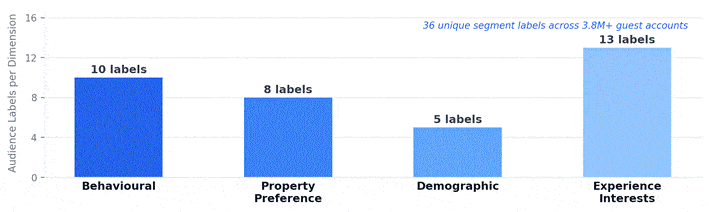
Figure 1 — Audience labels delivered per segmentation dimension (36 total across 3.8M+ guest accounts)
| Dimension | Objective | Archetypes | Signal Sources |
| Behavioural | Score every guest against loyalty, recency, and booking patterns | 10 | Reservation history, booking channel, advance window, frequency, recency |
| Property Preference | Classify guests by the type and quality tier of properties they choose | 8 | Observed stay history scored across property tier, type, and category |
| Demographic | Build travel party profiles from reservation and CRM data | 5 | Adult/children counts per reservation, CRM age group, gender, country |
| Experience Interests | Translate 34 CRM interest flags into 13 weighted interest categories | 13 | CRM interest flags (weighted normalisation) + property context lookup |
Four methodology principles governed the engagement:
No manual prep, ever. All pipelines handle messy raw CRM exports directly — encoding issues, missing columns, separator variations, and option-set codes resolved automatically.
Observed behaviour, not self-report. Every segment label is derived from what guests actually did — stays booked, properties chosen, channels used — not from surveys or declared preferences.
Built for marketing analysts, not data teams. Each segmentation dimension was accompanied by full business documentation explaining every label in plain language — written for CRM managers, not engineers.
Cross-dimension from the start. Every guest account carries all four segment labels simultaneously, enabling compound audience queries without touching the CRM query interface.
Results
From Raw Data to a Full Audience Intelligence Layer
The engagement delivered three categories of output — working segmentation models, business documentation, and a strategic analysis workbook.
Behavioural Archetype Distribution
Every guest account was scored across 10 behavioural archetypes — from Loyal High-Value and Early Planner to Dormant and OTA Hopper. The distribution below shows how the 3.8M guest base divides across these archetypes, enabling the marketing team to quantify retention opportunity, reactivation risk, and channel loyalty in a single view.
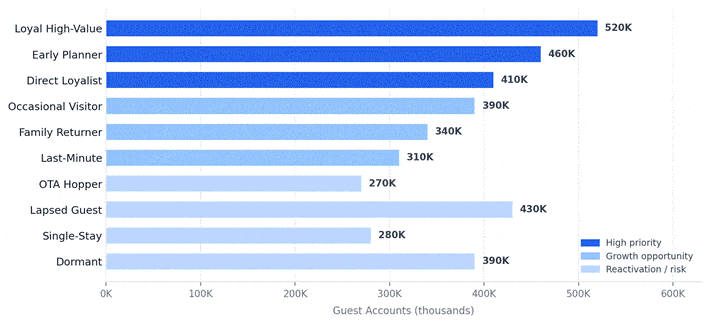
Figure 2 — Guest account distribution across 10 behavioural archetypes (illustrative; based on engagement output structure)
Cross-Dimension Audience Matrix
The heatmap below illustrates audience size at the intersection of behavioural segment and property preference — one of three cross-tabulation matrices delivered. Darker cells indicate larger addressable audiences. The matrix immediately reveals, for example, that Dormant guests are concentrated in the Standard Camp and Apartment tiers — a distinct reactivation opportunity that no single-dimension model could surface.
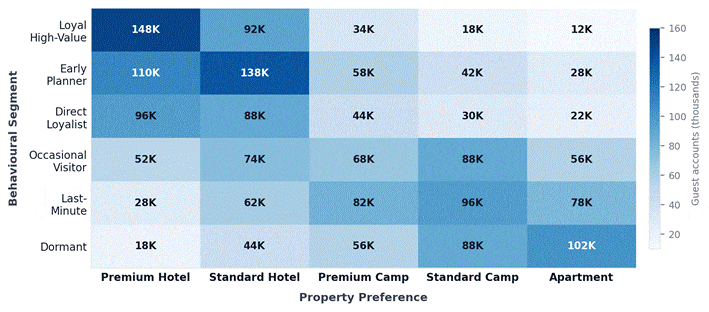
Figure 3 — Audience size (thousands) at intersection of Behavioural Segment × Property Preference (illustrative; based on engagement output structure)
Strategic Prioritisation: Four-Way Combination Ranking
Beyond individual matrices, the output included a four-way combination prioritisation table — every unique combination of all four segment labels ranked by account count and average revenue, with A–E priority tiers assigned. For the first time, the marketing team could identify, size, and target audiences defined by simultaneous conditions across all four dimensions.
| Segment Dimension | Labels | Accounts Covered | Documentation |
| Behavioural Segmentation | 10 | 3.8M+ | ✓ Included |
| Property Preference | 8 | 3.8M+ | ✓ Included |
| Demographic Segmentation | 5 | 3.8M+ | ✓ Included |
| Experience Interests | 13 | 3.8M+ | ✓ Included |
| “We handed over a raw data export and received a complete audience intelligence layer. Every guest account now carries four segment labels simultaneously — we can define and size any audience we need without a single database query.” — Marketing Leadership, European Resort Group |
Why Graphite Note
Decision Intelligence Built for Scale
This engagement was not a proof of concept. It was a production-ready Decision Intelligence system delivered from raw data to a fully operational audience layer — covering 3.8 million accounts across four analytical dimensions.
| Capability | Description |
| Zero-friction deployment | Full engagement runs from a raw CSV export — no BI tool, no cloud dependency, no manual data preparation by the client. |
| Business-ready outputs | Every model is paired with plain-language documentation written for CRM managers and analysts — not data engineers. |
| Integrated audience architecture | Segment dimensions are designed to combine — enabling compound audience definitions that no single model could support alone. |
| No-code ML platform | Graphite Note’s platform enables ongoing model refresh and audience exploration without requiring a data science team on-site. |