
Client context
Challenge at a Glance
| Industry | Omnichannel Home Goods & Lifestyle Retail — US Market |
| Channels | E-commerce (primary), 18 physical locations, loyalty program with 1.1M members |
| Customer Base | 1.1M registered accounts; 420,000 with at least one purchase in prior 24 months |
| Data Available | 3 years of transaction history: order ID, customer ID, order date, order value |
| Problem | No visibility into which customers were drifting away, which were genuinely loyal, or what each was worth in future revenue |
| Goal | Score every repeat customer by churn risk and predicted future value — and use those scores to drive marketing decisions, not gut feel |
For context: in non-contractual B2C retail — where no subscription binds a customer and no cancellation signals departure — churn is invisible until it has already happened. Industry research consistently shows that the average US e-commerce business experiences annual churn exceeding 60%, with repeat customers representing just 21% of the buyer base but generating 44% of total revenue. The economics of getting this wrong are severe.
The problem
The Loyalty Program Had 1.1M Members. Nobody Knew Which 400K Were Already Gone.
The retail team treated all loyalty program members roughly the same. Marketing campaigns went to broad segments defined by recency alone — “bought in the last 90 days” versus “bought in the last 12 months.” Winback emails fired 180 days after last purchase, regardless of whether a customer had ever bought more than once or had historically spent $2,000 across a dozen orders. Acquisition and retention budgets were set by channel, not by customer value.
Three compounding problems made this expensive. First, high-value loyal customers were receiving the same discount offers as one-time buyers, unnecessarily eroding margin on customers who would have returned anyway. Second, genuinely at-risk customers with real revenue potential were falling through without personalised intervention — simply because no one knew they were at risk until months after the fact. Third, the marketing team had no principled way to decide how much to spend re-engaging a lapsed customer because they had no estimate of what that customer was worth if retained.
- No churn signal existed for non-contractual customers. A B2C retailer cannot see a cancellation. Without a probabilistic model, there is no early warning. By the time a customer’s absence becomes visible, the window for cost-effective re-engagement has often already closed.
- CLV was calculated as a backward-looking average. The finance team tracked average revenue per customer over the prior year. This number says nothing about what a given customer will spend in the next 90 days, or whether they are likely to return at all.
- Campaign ROI was unmeasurable by customer value. Without a CLV score per customer, it was impossible to calculate whether a $15 re-engagement voucher sent to a $21 CLV customer was worth it. Most weren’t. Many high-value customers were under-invested.
- The 38% at-risk segment was invisible. Nearly two in five repeat customers were below the 50% probability-alive threshold — more likely to have quietly churned than to buy again. No system flagged them. No campaign prioritised them differently.
The approach
Buy ‘Til You Die Modelling. Individual Scores for Every Customer.
Graphite Note applied a probabilistic CLV model — based on the Buy ‘Til You Die (BTYD) framework — to 3 years of transaction data across 420,000 customers with at least one purchase. Unlike a standard churn classification model, which requires a defined contract end point, BTYD models are designed specifically for non-contractual settings. They use purchase frequency, recency, and monetary value to infer, for each individual customer, the probability they are still “alive” and how much they are likely to spend across future time horizons.
The output is not a segment label. It is a row-level score for every customer in the database: their current probability of being active, their predicted number of purchases in the next 7, 30, 60, 90, and 365 days, and their CLV across those same horizons. This means every marketing decision — who to contact, with what offer, at what cost threshold — can be grounded in a forward-looking value estimate rather than a backward-looking average.
What the Model Calculates Per Customer
- Probability Alive: The current probability that the customer is still an active buyer. A score of 0.08 means an 8% chance the customer will purchase again. A score of 0.94 means near-certainty of future activity.
- Predicted Purchases (7 / 30 / 60 / 90 / 365 days): Forecasted transaction count across five time horizons, derived from the customer’s individual purchase pattern and recency.
- CLV (30 / 60 / 90 / 365 days): Estimated monetary value the customer is expected to generate across each horizon, calculated from predicted purchase count and average historical spend.
- Churn Risk Segment: Automatic classification into five bands — Very Low Risk, Low Risk, Medium Risk, High Risk, Very High Risk — based on probability-alive score.
- Days Since Last Purchase & Average Days Between Purchases: Behavioural context metrics that explain why a customer has been classified at a given risk level.
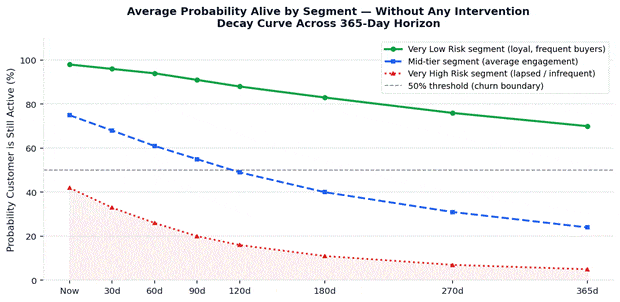
Figure 1. Average probability-alive decay curves by segment across a 365-day horizon — without any marketing intervention. The Very High Risk segment (red) crosses below 50% within the first 30 days, signalling customers who are already effectively churned. Mid-tier customers (blue) cross the threshold near day 90, creating a defined intervention window.
Results
248,000 Customers Scored. Five Segments. One Clear Action List.
The model scored all 248,000 repeat customers — those with two or more purchases in the prior 36 months — across the full CLV output suite. The results were immediately actionable: every customer had a probability-alive score, a risk segment, and a 30/90/365-day CLV estimate. The marketing team could, for the first time, ask and answer the question: “is this customer worth a $20 voucher?” for every individual in the database.
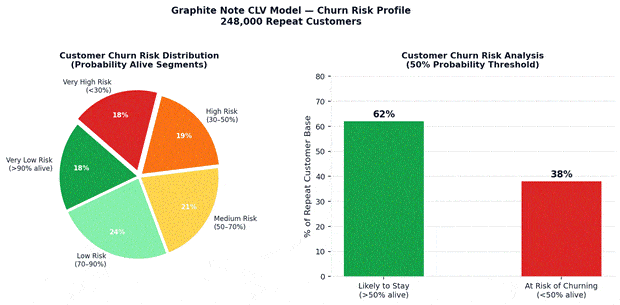
Figure 2. Churn risk distribution across 248,000 repeat customers (left) and binary classification at the 50% probability-alive threshold (right). 38% of the repeat base — approximately 94,000 customers — are more likely to have churned than to purchase again. This segment was entirely invisible before CLV modelling.
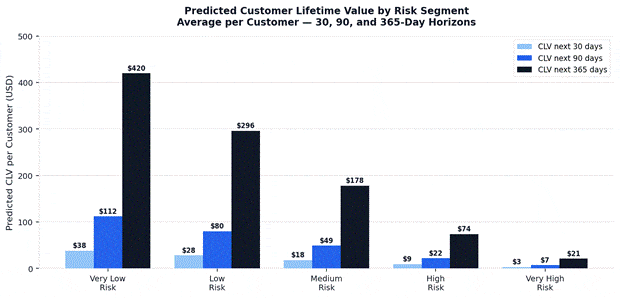
Figure 3. Predicted CLV per customer by risk segment across 30, 90, and 365-day horizons. The gap between Very Low Risk ($420 annual CLV) and Very High Risk ($21) is 20x — making undifferentiated marketing spend across both segments economically indefensible.
Segment Profiles and Actions Taken
| Segment | % of Base | Prob. Alive | CLV (90d) | Recommended Action |
|---|---|---|---|---|
| Very Low Risk | 18% | >90% | $112 | Loyalty reward, early access, VIP treatment. No discounting needed. |
| Low Risk | 24% | 70–90% | $80 | Nurture cadence, cross-sell recommendations, replenishment reminders. |
| Medium Risk | 21% | 50–70% | $49 | Engagement nudge, personalised “we miss you” with low-cost incentive. |
| High Risk | 19% | 30–50% | $22 | Winback offer calibrated to CLV. Suppress from brand campaigns. |
| Very High Risk | 18% | <30% | $7 | High-value sub-segment only: re-engagement with strong offer. Remainder: suppress to save budget. |
Financial Impact of Reallocation
The CLV scores enabled a reallocation of $4.1M in annual marketing and retention spend. Previously distributed by recency tier, the budget was restructured around CLV segment — increasing investment in Very Low and Low Risk customers (higher CLV, lower cost to retain) and reducing blanket spend on the Very High Risk tail, where the expected return on a standard win-back offer was negative after accounting for offer cost and redemption probability.
The secondary impact was on offer calibration. With a 365-day CLV score per customer, the team could set a principled ceiling on win-back spend: no offer sent to a Very High Risk customer would exceed 30% of their projected annual CLV. This alone eliminated an estimated $680K in annually wasted discount spend on customers whose expected lifetime value was below the cost of the intervention.
CLIENT VOICE
| “We had a million loyalty members and we were marketing to them like they were all the same person. The CLV model gave us a score for every single one. Now when someone asks why we’re sending a $25 offer to this customer but not that one, we have an actual answer. It’s not a hunch. It’s a number.” — VP of CRM & Retention, US Omnichannel Home Goods Retailer |
Why Graphite Note
Standard CRM segmentation groups customers by what they did last. CLV modelling scores them by what they are likely to do next, and how much that is worth. In a non-contractual B2C environment, the second question is the only one that makes retention spend defensible.
| BTYD CLV Modelling | Probabilistic customer lifetime value for non-contractual, B2C settings. Works on transaction data alone — no CRM integration or behavioural tagging required. |
| Individual-Level Scoring | Every customer receives their own probability-alive score, churn risk segment, and CLV across 30/90/365-day horizons — not a cohort average. |
| Churn Detection Without Labels | Identifies at-risk customers in the absence of cancellation signals. The only early warning system available to a non-subscription retailer. |
| Campaign Budget Calibration | CLV-based offer ceiling: no win-back spend exceeds a set percentage of the customer’s projected annual value. Eliminates negative-ROI discount campaigns. |
| CRM & ESP Integration via API | CLV scores and segment labels exportable via the Graphite Note Model Results API — enabling direct injection into email platforms, CRM systems, and paid media audiences. |