
Client context
Challenge at a Glance
| Industry | High-Precision Component Manufacturing |
| Geography | Europe — Single Production Site, Multiple CNC Lines |
| Data Available | 18 months of shift-level production logs, MES exports, tool lifecycle records |
| Baseline Scrap | 4.0–4.3% across production lines — above the 2–3% European sector average |
| Stated Goal | Reduce scrap by 2 percentage points. Sustain it. Understand what is driving it. |
For context: in high-precision discrete manufacturing, top-quartile European plants achieve scrap rates below 2%. The broad sector average sits between 3% and 5%. At 4%+, the client was losing material, machine time, and throughput capacity to defects they could not explain — let alone control.
The problem
Power BI Showed the Number. It Could Not Move It.
The quality team had invested in a Power BI dashboard connected to their MES. It displayed scrap rate by shift, by line, and by product family in near real time. Supervisors could see that Wednesday night shifts on Line 2 were consistently worse. They could see that scrap spiked in March and October. What the dashboard could not tell them was why — and without a causal answer, every proposed fix was a guess.
Three separate improvement initiatives had been launched in eighteen months. A tooling standardisation project addressed tool change intervals across lines. A raw material supplier audit was commissioned after incoming quality inspection logs showed variance in raw material stock hardness. A shift handover protocol was redesigned to reduce setup errors. Each initiative produced temporary improvement. None held. Scrap crept back toward 4% within two months of each intervention ending.
- The root cause was not singular. Multiple process variables were interacting simultaneously. A standard dashboard can show each variable in isolation. It cannot show which ones are causally driving outcomes when they move together.
- Correlation was misleading the team. Tool age and scrap rate moved together, but so did shift patterns and scrap rate, and so did coolant concentration and scrap rate. Without causal isolation, the team could not know which to prioritise.
- The cost was compounding. At 4% scrap across three CNC lines producing components, the material and rework cost exceeded €2.3M annually. Every month without an answer was a month of preventable loss.
- The 2 pp target had no roadmap. Leadership had set a clear goal. Engineering could not translate it into a ranked list of interventions because no model existed to show which drivers, if changed, would move the number.
The approach
CausalML, Not Correlation. Drivers, Not Dashboards.
Graphite Note applied a CausalML-based driver decomposition to 18 months of shift-level production data. The objective was not to predict scrap — it was to quantify the independent causal contribution of each process variable to the scrap rate, controlling for all others simultaneously.
This is a fundamentally different question from what a standard BI dashboard or even a regression model typically answers. Correlation tells you what moves together. Causal modelling tells you what would happen to the outcome if you changed one variable while holding all others constant. That distinction is what converts analysis into an actionable intervention list.
What Data Was Used
- MES production logs: 18 months of shift-level records including units produced, units scrapped, defect classification codes, and operator ID.
- Tool lifecycle data: CNC tool change timestamps, cumulative cutting hours per tool at time of each production run, and tool type by operation.
- Process parameter logs: Spindle speed, feed rate, coolant concentration, coolant temperature, and ambient shop floor temperature recorded at 15-minute intervals.
- Incoming material records: Supplier batch IDs, incoming hardness test results, and dimensional variance measurements for raw material stock.
- Maintenance records: Scheduled preventive maintenance logs, unplanned downtime events, and machine calibration timestamps.
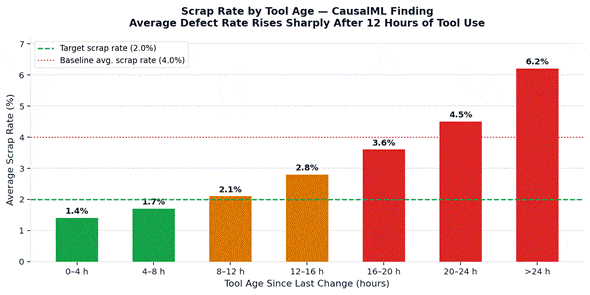
Figure 1. CausalML finding: scrap rate by tool age at time of production. Defect rates remain within target below 8 hours of tool use and rise sharply beyond 12 hours. This non-linear relationship was invisible in standard BI reporting, which showed only average scrap rate by shift.
Results
Seven Drivers. Three Required Action. One Number Moved.
The CausalML model identified seven statistically significant drivers of scrap rate variation. Of these, three had a causal effect large enough to justify targeted intervention. The remaining four were either structurally constrained (batch size is determined by customer orders, not production planning) or carried effects too small to prioritise ahead of the primary drivers.
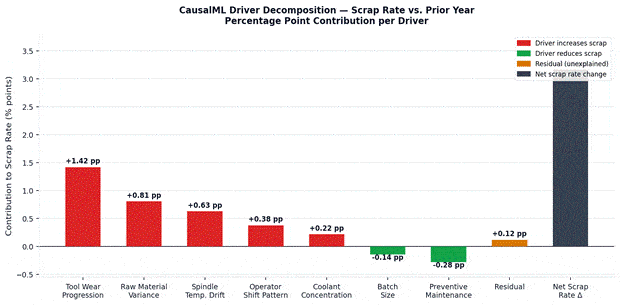
Figure 2. CausalML driver decomposition. Tool Wear Progression is the dominant driver at +1.42 pp, followed by Raw Material Variance (+0.81 pp) and Spindle Temperature Drift (+0.63 pp). Preventive Maintenance frequency emerges as the only controllable factor currently reducing scrap (−0.28 pp).
The Three Interventions That Moved the Number
| Driver | Impact on Scrap | Intervention Taken |
|---|---|---|
| Tool Wear Progression (+1.42 pp) | Largest single driver | Mandatory tool change at 10 hours (previously 24 hours). CausalML simulation showed this single change would recover 0.9–1.1 pp of scrap rate. |
| Raw Material Variance (+0.81 pp) | Second largest driver | Incoming material acceptance tightened: hardness tolerance reduced from ±8 HRB to ±4 HRB. Supplier batch pre-qualification introduced for Supplier B. |
| Spindle Temp. Drift (+0.63 pp) | Third largest driver | Coolant chiller setpoint reduced from 22°C to 18°C on all three lines. Thermal stabilisation period of 20 minutes added to shift start protocol. |
The tool change interval was the most counterintuitive finding. The team had assumed the existing 24-hour interval was conservative. CausalML showed that scrap rate at 20–24 hours of tool use was 4.5% on average — more than three times the rate in the first eight hours of tool life. The cost of more frequent tool changes was a fraction of the scrap cost they were preventing.
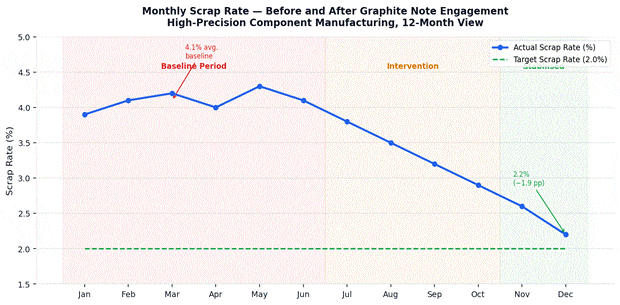
Figure 3. Monthly scrap rate across the engagement period. Baseline averaged 4.1% across January–June. Following phased intervention from July, scrap declined steadily to 2.2% by December — a 1.9 pp reduction against the 2 pp target.
Financial Impact
The financial recovery from a scrap reduction of this scale operates on two levels. The direct benefit — material and labour cost no longer consumed producing defective components — translates immediately to margin improvement. The indirect benefit is throughput: every scrapped unit consumed machine time that now produces a good component, effectively expanding capacity without capital investment or additional shifts.
The combined impact across both dimensions comfortably exceeded the client’s internal business case threshold within the first two quarters of intervention. A monthly refresh of the causal model ensures the gains are tracked and defended as production conditions evolve.
Across material cost recovery, avoided rework labour, and throughput gains on multiple production lines, the annualised financial benefit exceeded €1.4M — against an increased tooling cost from shorter change intervals that represents a fraction of that figure.
CLIENT VOICE
| “We had dashboards showing us scrap by line, by shift, by product. We had been staring at those numbers for eighteen months. Graphite Note looked at the same data and told us which three things to fix, in which order, and what the expected impact of each would be. We changed the tool intervals in week one. Scrap started moving the following month.” — Head of Manufacturing Engineering, European Manufacturer |
Why Graphite Note
Standard BI platforms are built for visibility. They answer the question: what is happening? CausalML answers a different question: what is causing it, and what would happen if we changed it? For manufacturers with complex, multi-variable production environments, the second question is the one that moves the metric.
| CausalML Driver Decomposition | Isolates the independent causal contribution of each process variable to a quality or efficiency KPI — controlling for all others simultaneously. |
| Simulation & What-If Analysis | Quantifies the expected scrap rate reduction from each proposed intervention before any operational change is made. Prioritises the highest-ROI actions. |
| Process Variable Integration | Connects MES data, tool lifecycle records, parameter logs, and incoming material data into a single analytical dataset without requiring IT infrastructure change. |
| Financial Impact Quantification | Translates percentage-point improvements into material cost recovery, throughput gain, and avoided rework labour — in the currency of the CFO. |
| Ongoing Monitoring Framework | Monthly refresh of the causal model detects drift in driver contributions as production conditions change, enabling proactive intervention before scrap climbs again. |